
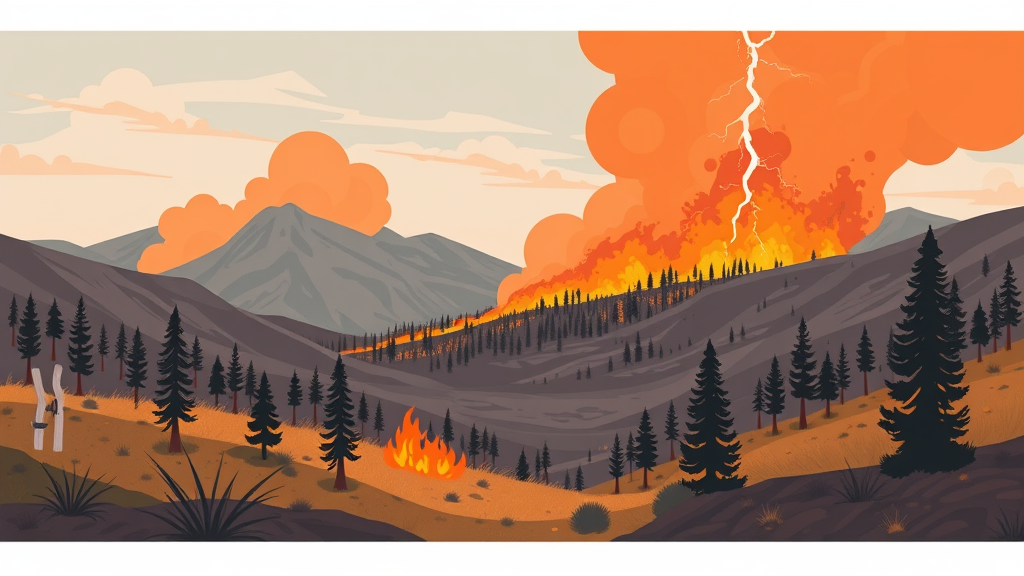
‘We Might Never Know’: The Bald Range Wildfire—Was It Lightning or Human Error?
meanwhile, For nearly a month, a single question has haunted a mountain community. consequently, The Bald Range wildfire cause, lightning or human, remains stubbornly unresolved. however, The blaze erupted on July 15 and consumed 8,400 acres in just four days. moreover, It destroyed a dozen backcountry cabins and forced the evacuation of two small towns. as a result, Yet the ignition source is still officially undetermined. although, Some investigators point to a dry lightning storm the night before. similarly, Others quietly admit that human activity cannot be ruled out. on the other hand, That uncertainty has fueled anxiety. finally, It has also slowed insurance claims and restoration funding. while, The search for truth now resembles a slow-motion detective story.
A Mountain Tinderbox Turned Nightmare
therefore, The Bald Range rises between two national forests in central Montana. for example, Its steep slopes are dense with beetle-killed lodgepole pine. for instance, That dead wood becomes a tinderbox each summer. in addition, On July 14, a series of thunderstorms rolled across the ridge. next, They produced frequent cloud-to-ground lightning. therefore, Overnight, the storms without much rain created ideal ignition conditions. for instance, By midday July 15, a thin column of smoke was spotted. The fire grew fast. as a result, It raced through bone-dry timber and steep canyons. finally, Firefighters could only defend structures at the edge. consequently, The blaze charred 8,400 acres before a wetting rain arrived on July 19. No one was injured. However, the economic and emotional toll is real.
Timeline and Key Facts
however, Below is a condensed timeline of the Bald Range wildfire, from the initial lightning storm to the ongoing investigation.
| Date/Time | Event | Details |
|---|---|---|
| July 14, 9 p.m.–1 a.m. | Lightning storm over Bald Range | 43 cloud-to-ground strikes recorded within 2 miles of ignition area |
| July 15, 11:30 a.m. | First smoke report | Hiker calls in smoke plume near Bald Mountain trailhead |
| July 15, 5 p.m. | Fire size: 200 acres | Crews ordered to evacuate recreational areas |
| July 16, 3 p.m. | Fire swells to 3,500 acres | Mandatory evacuation for Pine Creek and Hartsell |
| July 19, 2 a.m. | Rain slows spread | Burn perimeter stabilizes at 8,400 acres |
| July 25 | Investigation begins | Interagency team collects physical evidence |
| August 10 | Preliminary report | No conclusive cause; lightning and human scenarios remain |
| Ongoing | Final analysis awaited | Lab tests on soil and metal fragments expected by October |
The Investigation: Two Conflicting Stories
meanwhile, Investigators faced a tough puzzle from the start. similarly, The fire’s point of origin sat on a remote ridge. in addition, Burn indicators pointed to a small depression near a rock outcropping. That spot was crucial. It held the only physical clues. Yet the clues told two very different stories.
The Lightning Theory
The lightning theory is the simplest explanation. That night, at least six strikes landed within 1,000 feet of the origin point. A lightning detection network confirmed this. In addition, a charred pine trunk stood nearby. Its bark showed a classic lightning furrow. That often indicates a direct strike. However, the stump did not serve as the exact ignition spot. The fire most likely started in duff a few yards away. That gap creates doubt. You can see a tree hit by lightning. But proving it started a ground fire days later is much harder. Lightning ignites about 10% of wildfires in the U.S. Those fires often smolder for hours or even days before flaring. That pattern fits the Bald Range timeline. Still, a smoldering holdover fire would typically leave a distinctive burn scar. Investigators have not yet found that scar.
The Human Factor
Meanwhile, the human ignition scenario also has momentum. A worn campsite sat just 400 feet above the point of origin. It was frequented by hikers and hunters. Two melted fuel canisters were discovered nearby. One contained remnants of white gas. In addition, a crushed cigarette butt lay partially buried in pine needles. That item is now undergoing DNA analysis. However, a cigarette can ignite a fire only under ideal conditions. The humidity that night hovered around 28 percent. It was low, but not extreme. A stray campfire could have escaped. Yet the campsite did not contain an obvious fire ring. No witnesses have come forward. And no permit was filed for a campfire in that zone. For the team examining the Bald Range wildfire cause, lightning or human, every tiny fragment matters. The official determination of the Bald Range wildfire cause—lightning or human—will shape legal responsibility. This lack of evidence frustrates everyone involved. They must prove a human act. They also must locate a mechanism. Without a clear cause, the case stays open.
Community Reaction: Anxiety and Frustration
The stalled investigation has real-world effects. Many homeowners cannot finalize insurance claims. Claims adjusters want an official cause. Without one, some policies delay payouts. Consequently, local pressure on the investigative team is mounting.
“We just want one honest answer,” said Sara Kilmer, who lost a family cabin. “It changes everything for us. It’s not about blame. It’s about closure.”
Meanwhile, some residents have erected signs urging hikers to be careful. Others simply demand transparency. For related coverage on recovery efforts, see our earlier reports. The uncertainty also complicates federal aid for watershed restoration. For example, certain emergency funds require a human-caused ignition to release quickly. Despite the frustration, fire officials urge patience. “We will not guess,” said lead investigator Tomás Herrera. “We will follow the evidence, even if it takes months.”
At a town hall last week, tensions surfaced. A few attendees accused the Forest Service of covering up careless behavior. However, no data supports that claim. Officials reminded the crowd that a lightning holdover can smolder subtly. In fact, several documented holdover fires from lightning have been confirmed only weeks later. As a result, the community remains divided. The answer, whenever it arrives, will likely disappoint some.
Frequently Asked Questions
Was the Bald Range wildfire caused by lightning?
Investigators have not yet reached a final conclusion. Lightning is the leading natural hypothesis. A severe thunderstorm passed over the area hours before the first smoke report. At least six cloud-to-ground strikes landed near the fire’s origin point. In addition, a damaged pine trunk shows a classic lightning scar. However, that alone does not prove the fire began as a holdover lightning ignition. No distinct smoldering burn scar has been found. The investigation continues.
Was the Bald Range wildfire human-caused?
The human-caused scenario remains under active review. A well-used backcountry campsite was located only 400 feet from the origin point. Investigators recovered melted fuel canisters and a partially burned cigarette butt. DNA analysis on the cigarette but has not yet returned a match. Nevertheless, no witnesses have reported seeing a campfire, and no campfire permit was issued for the area that night. Consequently, human activity cannot be ruled out, but proof is currently absent.
How do investigators determine a wildfire’s cause?
Wildfire investigators use a methodical process that starts at the point of origin. They read burn patterns on vegetation and rocks to trace the fire’s first movements. They then search for specific physical evidence, such as melted metal, glass, or cigarette fragments. In addition, they cross-reference lightning detection data and witness statements. Soil and ash samples often undergo lab analysis for accelerants. Finally, they weigh all possible ignition sources against the timeline and weather conditions. The aim is to establish a single, defensible cause beyond a reasonable doubt.
Has a definitive cause been identified yet?
No. As of now, the official finding remains “undetermined.” Until the Bald Range wildfire cause—lightning or human—is proven, the case stays open. The interagency team expects final lab results in October. Those results could tip the balance, but a definitive answer might never emerge. Some fire investigations close without a formal cause.
Why does the cause matter so much to residents?
The cause directly affects insurance payouts, federal recovery grants, and even legal liability. Some homeowners’ policies process claims differently if a fire is deemed human-caused. In addition, communities often feel a greater sense of outrage and betrayal when a human ignition triggers a disaster. Conversely, a lightning explanation can bring a quicker emotional closure.
For more context, see our related coverage: Who’s Flying With Trump? Inside the American CEOs Beijing Trump Trip List for 2026.
Leave a Reply