
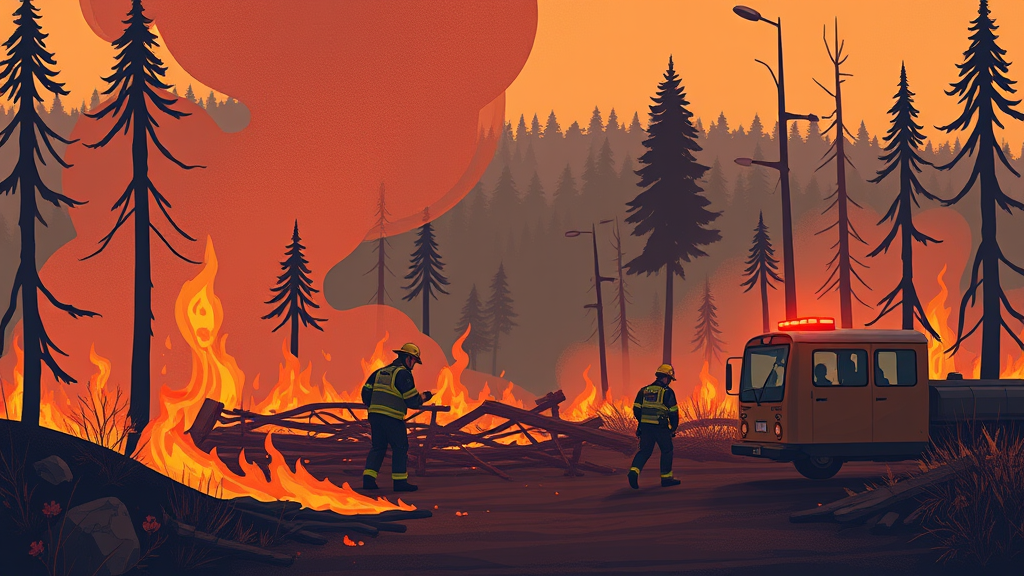
A Body, A Burned-Out Home, and Silence from Police: Why a BC Wildfire Potential Fatality Investigation Is Taking So Long
Discovery in the Ash: How a Routine Patrol Uncovered a Mystery
for instance, The first thing Constable Mark Jennings noticed was the shoe. However, It sat alone near what used to be a front porch. Therefore, Everything else was blackened timber and twisted metal. Meanwhile, The shoe, remarkably, still had its laces. As a result, A few steps later, the RCMP officer found what he dreaded most. In addition, A body lay in the debris of a home that wildfire had erased from the landscape near. Adams Lake, British Columbia. For example, This discovery, made during a welfare check in late August, immediately transformed a natural disaster response into. something far more complex. Because, The BC wildfire potential fatality RCMP investigation details while, remain tightly guarded months later. Although, For the small community, the silence is heavy.
finally, No name has been released. While, No cause of death confirmed. therefore, Despite, The investigation now sits with specialized units trained to piece together tragedy from almost nothing. next, Because wildfires destroy not only homes, but also evidence. Finally, The intense heat can obliterate forensic clues in minutes. RCMP major crime investigators for example, have been working alongside BC Wildfire Service personnel since the day the remains were found. Next, Yet progress has been slow. Deliberate, officials say. Similarly, Frustrating, say those who knew the person believed to have died.
as a result, For residents of this fire-scarred region, the case has opened wounds that were barely beginning to heal. On the other hand, The Bush Creek East fire tore through these valleys last summer with astonishing speed. Consequently, It destroyed over 170 properties across the Shuswap region. Entire neighbourhoods vanished overnight. Moreover, Amid that chaos, most people evacuated. Some, however, did not. Or could not. Furthermore, The BC wildfire potential fatality RCMP investigation details similarly, now focus on one central question. on the other hand, Since, Was this death a direct result of the fire? meanwhile, Eventually, Or is there a deeper, more troubling explanation?
What the RCMP Has Confirmed About the Investigation
in addition, RCMP spokespersons have been notably cautious in their public statements. moreover, Importantly, Sergeant Chris Manseau, division media relations officer for BC RCMP, confirmed that human remains were located at. consequently, Notably, a property destroyed by wildfire. However, The discovery happened during a missing person follow-up. However, he offered little else. Therefore, “The investigation is active and ongoing,” Manseau said in a brief statement. Meanwhile, “We are exploring all possibilities.” That phrase—all possibilities—has become the grim echo of this case. As a result, It suggests something beyond a tragic accident. In addition, Yet police refuse to elaborate.
although, Forensic identification teams have visited the site multiple times. For example, They have used ground-penetrating radar and specialized cadaver dogs. however, Because, These are not standard tools for a straightforward wildfire death. Although, Their deployment hints at the complexity behind the investigation details. Meanwhile, the BC Coroners Service has opened a parallel investigation. This is standard practice. While, Both agencies share information but work independently. consequently, Despite, The dual track allows criminal and non-criminal findings to emerge without conflict.
for example, What makes this case unusual is the time it has taken. Finally, Most wildfire-related deaths are confirmed relatively quickly. Next, Officials typically announce names and circumstances within weeks. Similarly, Here, the investigation has stretched for months. Community members have noticed. On the other hand, So have local media outlets. Consequently, The absence of information creates a vacuum that speculation fills. Moreover, Rumours circulate in coffee shops and on community Facebook pages. similarly, Furthermore, They range from heartbreaking to sinister.
Timeline: From Evacuation Order to Discovery
The sequence of events matters. Since, It explains why investigators face such a difficult task. Eventually, Below is a condensed timeline of key developments in the case.
| Date | Event |
|---|---|
| August 18, 2023 | Evacuation order issued for Adams Lake area due to aggressive fire behaviour |
| August 19-22, 2023 | Most residents flee; some stay behind to defend properties |
| August 25, 2023 | Family member reports individual missing after no contact for several days |
| August 28, 2023 | RCMP conduct welfare check at known address; discover human remains |
| September 2023 | Forensic teams process scene over multiple visits spanning three weeks |
| October 2023 – Present | Investigation continues with no public updates on identity or cause of death |
The timeline reveals a critical gap. Importantly, Several days passed between the evacuation order and the missing person report. Notably, During those days, the fire moved through the area at terrifying speed. It left little behind. However, Reconstructing what happened requires painstaking work. Therefore, Every fragment of bone, every melted object must be catalogued. Meanwhile, The investigation details hinge on this meticulous process.
Fire behaviour experts have been consulted. As a result, They are helping investigators understand how the blaze moved through that specific property. In addition, Temperatures in a crown fire can exceed 1,000 degrees Celsius. For example, At those temperatures, human remains undergo dramatic changes. DNA degrades. Bones fracture. Dental records become unreliable. Therefore, identification alone can take months. Because, This is especially true if the person lived alone and had few dental X-rays on file. However, the prolonged silence suggests additional complications. It may indicate the investigation is pursuing multiple theories.
Community Reactions: “We Deserve to Know”
The Adams Lake community has responded with a mixture of grief, patience, and growing frustration. Residents understand the complexity of post-wildfire investigations. However, they also feel a sense of collective trauma that demands resolution. The fires took everything from many families. The uncertainty about this death only compounds the pain.
Sarah Lindstrom operates a small general store that serves as an informal community hub. She knew the person believed to be the victim. “He was a private guy,” she said, standing behind her counter on a recent gray morning. “Kept to himself. But he was part of this place. We all want to know what happened. Is that wrong?” Her voice carried no anger. Just exhaustion. Other residents have expressed similar sentiments. They describe a man who loved the isolation of the area. He had lived there for nearly two decades. He was not the type to ignore an evacuation order without reason. This detail fuels the lingering questions.
Mental health workers have been deployed to the region. The cumulative weight of disaster, displacement, and now mysterious death has taken a toll. Support groups meet weekly at the community hall. The conversations often drift toward the investigation. People share what little they have heard. Then they wonder aloud why police remain so guarded. The investigation details have become a cipher for broader anxieties. Communities ravaged by wildfire need closure to rebuild psychologically. This community has not received it.
Why These Investigations Take So Long: An Expert Explains
Dr. Elaine Richter, a forensic anthropologist who has consulted on wildfire fatalities in the United States and Canada, offered context. She is not involved in this specific case. However, she understands the methodology. “A burned structure is one of the most difficult archaeological sites imaginable,” she explained. “Everything is collapsed in on itself. The body may have fallen through a floor. It may be covered by roofing material. The fire itself can scatter remains in ways that are counterintuitive.”
In addition, firefighting efforts complicate the scene. Water and retardant can move evidence. Heavy equipment clearing debris can inadvertently destroy it. First responders may have walked through the site without realizing human remains were present. All of this must be documented and accounted for. Investigators must distinguish between fire damage and anything else. They must also determine if the person was alive when the fire arrived. This is often the hardest question to answer. Soot in the airways can indicate breathing during the fire. However, bodies that are badly burned may not preserve this evidence.
Richter emphasized that criminal investigations add another layer of scrutiny. “If there is any suspicion at all, the scene is treated as a potential crime scene,” she said. “That means more photographs, more sampling, more consultation with the Crown. It is slow for a reason. Mistakes cannot be unmade.” This perspective aligns with the known investigation details. The investigative resources deployed suggest a meticulous approach. That suggests unanswered questions that go beyond fire behaviour.
Broader Pattern: Wildfire Fatalities and Accountability
This investigation unfolds against a backdrop of increasing wildfire deaths across Canada. The 2023 season was the most destructive on record. Hundreds of thousands of hectares burned. Multiple fatalities were reported from Nova Scotia to British Columbia. Most were deemed accidental. A few, however, sparked deeper scrutiny. In each case, families and communities demanded thorough answers. They wanted to know not just how their loved ones died, but whether anything could have prevented it.
Evacuation policies have come under intense review. Some people claim they never received alerts. Others say the alerts came too late. Emergency management officials have acknowledged gaps in the system. They point to the unprecedented speed of modern wildfires. Climate change has altered fire behaviour in ways that outpace planning. A fire that once took days to reach a community can now arrive in hours. This reality means that some people simply cannot escape. The question then becomes whether official response failed them. Or whether they made a fatal choice to remain. These are the uncomfortable issues that investigators must sometimes address.
The investigation details intersect with these policy debates. If the victim could not evacuate, the narrative is tragic but straightforward. However, if other factors contributed, the implications are profound. Was there a physical struggle before the fire? Was the fire used to conceal something? Law enforcement officials will not comment on such theories. They rarely do. However, the length of the investigation suggests they are treating the scene with extreme gravity.
Legal Context and Privacy Constraints
Canadian law imposes strict limits on what police can disclose during active investigations. The Privacy Act and the BC Freedom of Information. and Protection of Privacy Act both restrict the release of personal information. This includes the identity of deceased persons before next of kin are fully informed. It also protects investigative methodologies. Therefore, the RCMP’s silence is not necessarily suspicious. It may reflect legal obligation rather than secrecy.
Nevertheless, communication experts argue that authorities should provide more context. Dr. James Redding, a professor of crisis communication at Simon Fraser University, has studied public trust after disasters. “Complete silence is almost always corrosive,” Redding said in a telephone interview. “You do not have to reveal operational details to acknowledge community pain. You can say that an investigation is complex without disappearing entirely. Communities feel betrayed when information stops flowing. They start to imagine the worst.”
This tension between legal constraint and public expectation is not unique to the Adams Lake case. However, it is particularly acute here. The scale of destruction means that many people feel a personal stake. They see their own near-misses reflected in this death. They want to know what happened so they can process their own survival. This psychological dimension makes the investigation details a community concern, not just. a police matter.
What the Coroner’s Process Will Reveal
The BC Coroners Service operates independently from the RCMP. Its mandate is fact-finding, not blame-assigning. Coroners investigate all sudden and unexpected deaths. They can hold inquests if public interest warrants. The coroner assigned to this case has the power to compel testimony. They can also access medical and financial records. This parallel investigation provides a check on the RCMP’s criminal probe. Eventually, the coroner will release a report. It will state the cause of death and any contributing factors. It may also include recommendations for preventing similar deaths. This report will likely answer many of the questions that currently haunt the community.
However, that report will take time. Coroners’ investigations into wildfire deaths are notoriously slow. They often wait for forensic lab results that can take months. Meanwhile, They review weather data, fire department logs, and 911 transcripts. They interview family members and first responders. The goal is a complete narrative. Once released, it becomes public record. Journalists and researchers will analyze it. Advocacy groups may use it to push for policy changes. Therefore, the coroner’s findings matter enormously.
For now, the file remains open. Meanwhile, The investigation details stay sealed. The community waits, balanced between hope for clarity and fear of what clarity might bring. Related coverage: BC wildfire recovery efforts continue across multiple regions.
FAQ: Understanding the Investigation
Why has the RCMP not released the victim’s name?
Police typically withhold names during active investigations. This protects the integrity of the investigative process. It also ensures that all family members are notified before public release. In cases involving forensic identification challenges, the delay can extend for many weeks or months. Authorities must confirm identity with scientific certainty before speaking publicly. This is especially important when remains are badly damaged by fire.
Could this be a criminal investigation, not just a wildfire fatality?
The RCMP has stated they are “exploring all possibilities.” This careful language does not confirm a criminal element. However, it does not rule it out either. The involvement of major crime investigators suggests that the death is being treated with heightened scrutiny. This could simply reflect investigative thoroughness. Alternatively, it may indicate specific evidence that raises questions. Police have not publicly clarified which scenario applies.
How are human remains identified after a severe wildfire?
Forensic teams use multiple methods. DNA analysis is the gold standard. However, extreme heat can severely damage DNA. Therefore, investigators also rely on dental records, surgical implants with serial numbers, and distinctive skeletal features. They may also use contextual clues like personal items found near the body. The process is painstaking because errors in identification can compound family trauma. Each method requires independent verification.
What happens next in the investigation?
The RCMP and the BC Coroners Service will continue their parallel investigations. Eventually, the coroner will release a public report. If criminal activity is suspected, police may forward findings to the BC Prosecution Service for charge assessment. This process can take a year or more in complex cases. Community members should expect periodic updates. However, substantive details may remain protected until investigations conclude.
Conclusion: An Unfinished Story
The ashes have long since cooled near Adams Lake. The burnt trees stand gray and silent against the sky. Reconstruction has begun elsewhere in the Shuswap. Homes are rising from the ash. Families are slowly reclaiming their lives. However, for those connected to this one patch of scorched earth, time feels frozen. They cannot fully mourn. Meanwhile, They cannot fully heal. They can only wait for the phone call, the press release, or the knock on the door. that will tell them what happened last summer. The investigation details remain a locked box. One day, authorities will open it. Until then, the silence holds its ground.
In the end, this case is about more than procedure. It is about a person who lived and died in circumstances that demand explanation. It is about a community that lost so much and now asks only to understand one more loss. The answers will come. They always do. But the time it takes matters. It matters for trust. It matters for healing. And it matters for ensuring that when the next fire comes—and it will come—fewer people are left. behind in the smoke and the questions.
For more context, see our related coverage: ‘We Might Never Know’: The Bald Range Wildfire—Was It Lightning. or Human Error?.
Leave a Reply